do moths squeak?
Most people have heard of the Death's-head Hawkmoth's notorious squeaking (mostly through Instagram reels), but there are actually a wide variety of moths that can make sounds that are detectable by the human ear.
The Death's-head Hawkmoth is native to areas of Africa, Southern Europe, and the Middle East, with its name referring to any of the three species in the genus Acherontia. The genus name, Acherontia, relates to the river Acheron, which is a real river in Greece that was heavily mythologized as a boundary between our world and the Underworld. Even their subspecies names, Lachesis, Atropos, and Styx, refer to two of the Fates (Lachesis the Measurer and Atropos the Inflexible) and the Underworld's mythical river Styx. Accordingly, the Death's-head Hawkmoth has no lack of myth surrounding it either, with the species being one of the most infamous due to its inclusion in famous literature, film, and omens.
Beyond that, though, you have probably heard of them for one of their most unique features: their ability to squeak. When threatened, the Death's-head Hawkmoth will release a loud chirp from their mouthparts by inhaling and exhaling air through their proboscis, which vibrates their epipharynx like an accordion, producing that amazing squeak! While they are unique in their exhalation through the mouthparts, there are other types of moths that produce loud squeaks as well!
As an Ontario-based moth-er, I am always searching for new facts about my local species. For the past four years, I worked with Ontario Parks and conducted extensive mothing initiatives throughout the parks, which has cumulated in my finding of 450 species in MacGregor Point. Through this research, I have encountered some oddballs who make noise!
It is a common trait in tiger, tussock, and lichen moths that they produce some variation of ultrasonic clicking (acoustic aposematism), but it is only audible in a select few Ontario species. They all have a specialized organ in their thorax that vibrates to create sound; accordingly, they have hearing organs in their thorax as well! The Isabella Tiger Moth, a common sight throughout much of Canada in its larval form (the Wooly Bear), also uses auditory squeaks as a defence mechanism. They also use it as a response to restraint or disturbance, as well as for courtship purposes! Interestingly, most accounts of the Isabella Tiger Moths's sounds list them as ultrasonic and therefore not audible to the average human; however, they are audible (as I have heard them), whether it is just the general sound of their bodily vibration as they produce the clicks or the clicks themselves.
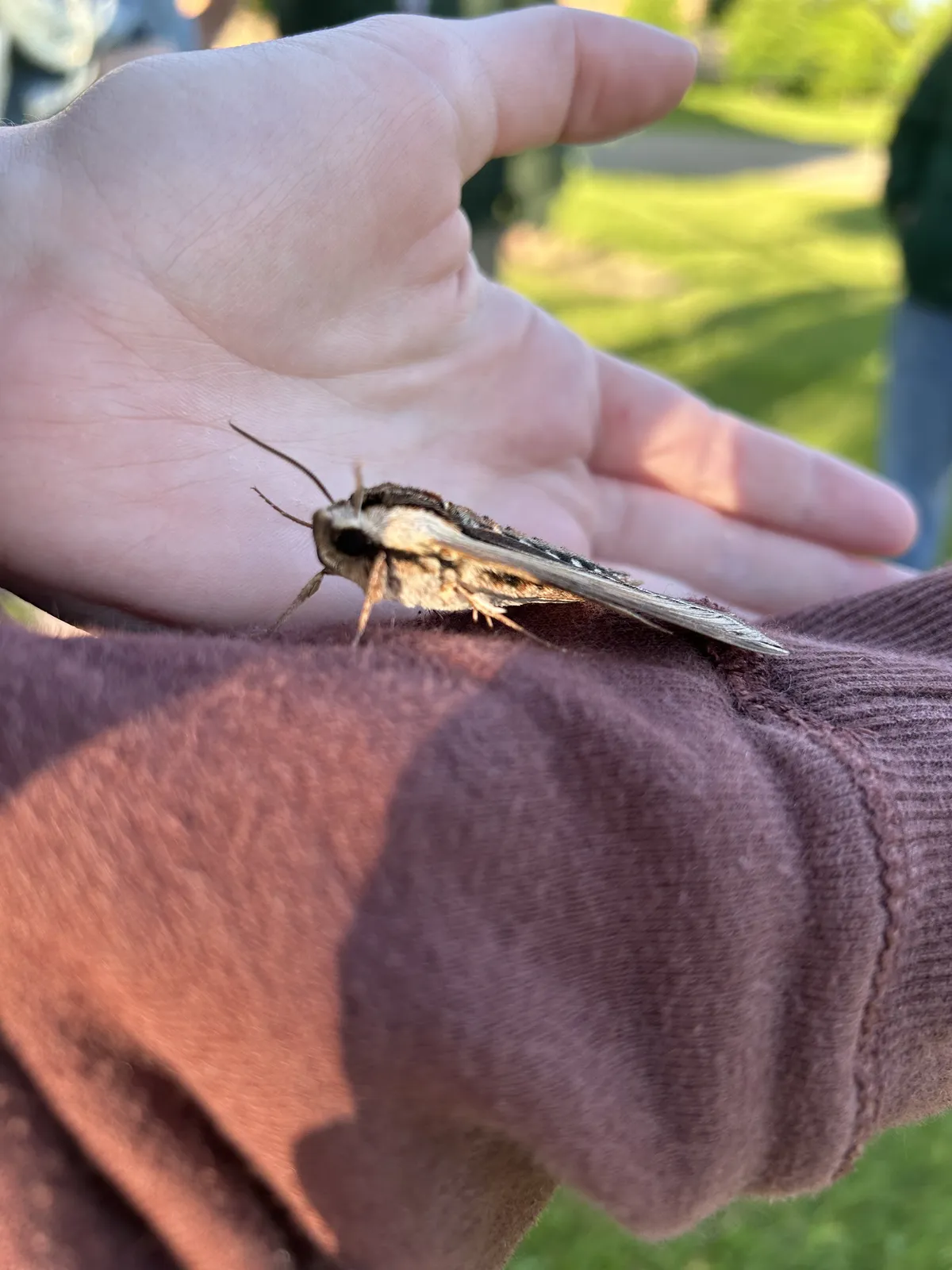
I have never been able to get a straightforward answer about this next species, but a few years back when I was in Peterborough, I had a Laurel Sphinx Moth crawling up my arm. Evidently, he was pretty upset to be being disturbed, as he was sprinting around and doing the moth-thing where they rotate their heads back and forth. However, he was also creating a squeaking sound! I wish that I had a video of it, but it was very quiet. I've asked a few mothing experts about this, but they have maintained that most local sphinx moths don't squeak. It seems as though, in addition to the Death's-head Hawkmoth, there may be a larger population of squeaking sphinx/hawk moths than we currently know!